Mandala Tattoos: The Complete Guide
Radial designs blooming from a center point — petals, dots, lace and geometry in perfect symmetry, from a two-inch accent to a full back.
Mandala means "circle" in Sanskrit, and the mandala — a radial pattern organized around a center — is one of humanity's oldest sacred diagrams, used in Hindu and Buddhist practice as a map of the universe and a tool of meditation. As tattooing, mandalas keep that sense of ordered calm: concentric rings of petals, dots, teardrops and lace, mirrored perfectly around the center point.
Modern mandala tattooing blends the sacred diagram with ornamental and dotwork technique, and ranges from small, simple centerpieces to enormous multi-session back and sternum compositions layered with flowers, jewels and geometric frames.
Mandala at a glance
| Line weight | Fine to medium lines in rings, with dotwork shading for depth |
|---|---|
| Palette | Usually black only; petals, dots, lace and scallops in perfect symmetry |
| How it ages | Fine dotwork rings soften first; well-spaced rings stay calm for decades |
| Best placements | Sternum, center of upper back, shoulder, elbow, knee and thigh |
| Minimum size | Simple mandalas at 2 inches; layered ones need 4 to 6 inches |
How Mandala designs are drawn
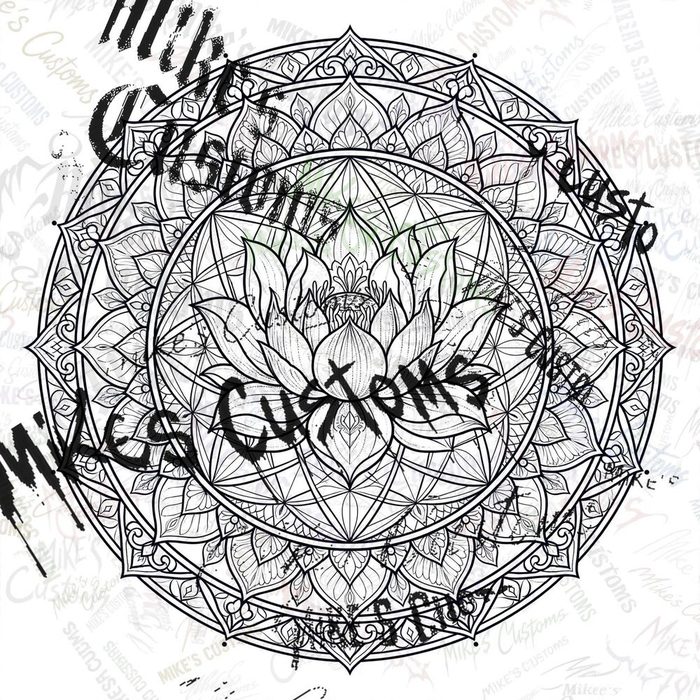
A mandala design is built in rings: a defined center (a dot, a flower, a gem), then successive bands of pattern — petals, stippled gradients, line lace, scallops — each ring echoing or contrasting the last. Symmetry is total: the design is drawn once as a wedge and mirrored around the circle. Line weights are usually fine to medium, with dotwork shading giving the rings their soft depth; some mandalas incorporate a lotus, an unalome, or an animal or moon at the center.
Best placements for Mandala tattoos
Mandalas belong on the body's natural centers and round surfaces: the sternum (the classic under-breast placement), center of the upper back, shoulders, elbows, knees, the solar plexus, and the thigh. Placement precision matters — a mandala two centimeters off the sternum's center reads as a mistake, so the stencil is set with the body standing naturally and checked in a mirror before a single line is tattooed.
Mandala placement precision goes beyond centering. A sternum mandala must account for the shape and movement of the chest it sits on: the lower rings curve with the body, sizing is checked standing and breathing normally, and a design drawn as a flat circle may need its lower petals lengthened or spaced to sit correctly rather than bunching. Shoulder mandalas work because the ball of the shoulder is a natural center, but the design will fold when the arm lifts, so the wearer should choose the pose in which it must read perfectly, usually the arm at rest. Knee and elbow mandalas turn the joint into the center flower, a striking choice that accepts constant folding through the middle of the piece and usually a touch-up at the center where skin works hardest. Symmetrical mandalas placed in pairs, on both thighs or both shoulders, should be planned together even if tattooed months apart, because matching a healed piece's exact diameter and line weight later is harder than stenciling both from the same file. Flat upper-back skin remains the most forgiving canvas for a first large mandala.
How big does a Mandala tattoo need to be?
A simple mandala reads at two inches; a layered, detailed one needs four to six to keep its rings distinct, and full back or sternum compositions run far larger. The constraint is ring spacing: as ink settles over the years, tightly packed rings crowd, so detailed mandalas must be sized so each band keeps its air. When in doubt, bigger and airier beats smaller and denser, every time.
How Mandala tattoos age
Mandalas age like the geometric family they belong to: they stay readable and keep their calm, with the finest dotwork rings softening first. Well-spaced rings age gracefully; over-dense ones blur toward a single texture — still pretty, less diagram. Bold-centered mandalas with graduated detail (boldest at the core, finest at the rim) are drawn for the decade view and reward it.
Healing a mandala is mostly about protecting symmetry from accidents. A single scab pulled from one petal leaves an asymmetry the eye finds every time, because the rest of the design is a pattern of perfect repeats, so mandalas over moving or rubbed areas need their first week planned carefully, loose clothing, no straps crossing the rings, no sleeping directly on a fresh back piece. Dotwork rings heal with fine flaking rather than a heavy scab, which helps, but they are also the first passages to lighten with age and sun. In session terms, a detailed mandala is drawn once and tattooed in rotations, the artist turning the work or the client to keep each repeat consistent, and large pieces are sensibly split so the outer rings are added over healed inner work rather than rushed. Mandalas suit patient, pattern-minded people who find the symmetry itself meaningful and who will give a detailed design its full size. They do not suit anyone who wants an off-center, casual placement, a dense design compressed small to save money, or perfect mirror symmetry expected from a body part that is visibly asymmetrical.
Choosing a Mandala design
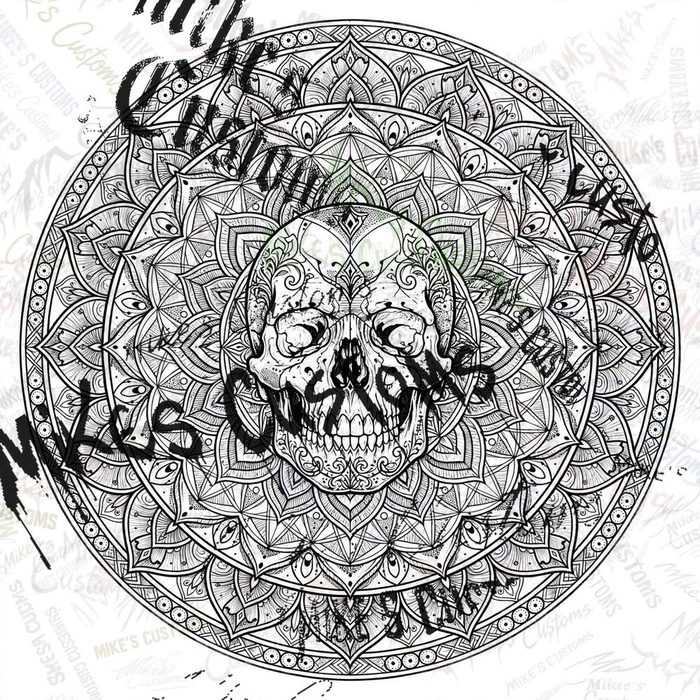
Our mandala designs are drawn as true radial files — the symmetry in the linework is exact, so your artist's transfer is the only variable. For sternum and back compositions, order custom with the placement named: a mandala engineered for the sternum's curve differs from a flat back piece, and we draw for the body you name.
One more choosing test for a mandala: print it at the exact size you plan and tape it to the body part, then look at it in a mirror from across the room. The rings you can still separate at that distance are the rings that will survive healing and age. If the outer lace collapses into a grey halo on paper, it will do the same on skin, and the fix is a larger size or fewer, bolder rings, decided before the stencil ever touches you.
Browse Mandala designs Order a custom Mandala design
Related style guides
- Tribal — Bold black flowing shapes rooted in indigenous tattoo traditions — Polynesian, Māori, Samoan, Bornean and Haida — and the sharp, sweeping tribal style that swept the 1990s.
- New School — Tattooing turned cartoon: exaggerated proportions, graffiti energy, candy color and characters that burst off the skin with thick outlines and wild perspective.
- Minimalist — The least ink that can carry the meaning: tiny symbols, single-line drawings, small icons and quiet marks chosen for personal significance over spectacle.
New to all of this? Start with how to choose a tattoo design that ages well, then the complete aftercare guide for what happens after the appointment.