Cherry Blossom Tattoo Meaning: Beauty That Knows It Is Brief
Sakura means a short, bright life loved harder because it ends — Japan's emblem of impermanence, fresh starts, and lives that fell at their peak. The forms, the honest truth about pale pink ink, and the sizes that keep five petals separate for decades.
A cherry blossom tattoo means beauty that knows it will not last — and is loved harder because of it. In Japan the blossom, sakura, is the standing symbol of a short, bright life: it blooms in a rush, holds for days, and falls while it is still beautiful. People wear it for a season of life that ended too soon, for a person who was here briefly and mattered completely, for their own youth, or as a reminder pinned to the skin that nothing good is permanent and that is not a reason to look away.
It is a gentle image with a serious core. Underneath the pink sits mortality, and the Japanese idea often named with it — mono no aware, a tender sadness at the passing of things — is exactly what gives a blossom tattoo its weight. Without that, it is just a pretty flower. With it, it is a whole way of seeing.
Sakura in Japan: hanami, soldiers, and falling petals
Cherry blossom viewing, hanami, has been a national ritual in Japan for well over a thousand years — first among court nobles, then everyone. Families and workmates still gather under flowering trees each spring to eat, drink, and sit inside a beauty everyone present knows will be gone within the week. The party is not in spite of the brevity. The party is because of it.
That pairing of celebration and impermanence runs through Japanese art, poetry, and tattooing alike. In the samurai era the blossom became linked to the warrior's ideal: a life lived fully and surrendered without clinging, falling at its peak rather than withering on the branch. Falling petals carried that image into the Second World War, when sakura were painted on aircraft and the blossom was bound up with young lives given early — a history worth knowing, because it is why older Japanese viewers may read a blossom tattoo with more gravity than a Western wearer expects.
In modern Japan the flower is also simply spring itself: school years and fiscal years begin as it blooms, so sakura carries beginnings, graduations, and fresh starts alongside the older, sadder meanings. A blossom tattoo can honestly hold both — an ending mourned and a beginning chosen — and many do.
| Form | What it tends to mean | Drawing notes |
|---|---|---|
| Single blossom | One brief, bright moment or person; a beginning | Works small if petals stay bold; five notched petals must stay separate |
| Branch in bloom | A season of life, growth, family, time passing | Needs length — forearm, ribs, or shoulder run; branch line carries the flow |
| Falling petals | Letting go, grief, a life that ended at its peak | Scattered petals need open skin between them or they read as spots |
| Blossom with temple or torii | Place, heritage, pilgrimage, memory of Japan | Architecture wants size; keep the building simple behind the flowers |
| Blossom in wind bars | Change carried forward, fate, movement through life | Classic irezumi background; petals ride the black wind shapes |
| White blossom | Purity, mourning, a quieter remembrance | Usually rendered in black and grey with open skin as the white |
Read the table as a starting point, not a code book. As with a rose tattoo, where color and thorns edit the sentence, a blossom's form edits this one — and the wearer's own season is the final editor.
Blossom, branch, or petals in the wind
The three common forms behave like three different tenses. A single blossom is the present tense: this moment, this person, held still. It is the most chosen form for a first blossom tattoo, and the most forgiving to place, because a round flower sits well on an ankle, a wrist, behind an ear, or on a shoulder blade.
A branch is the past tense widening into story: buds, open flowers, and a fallen petal or two on one stem say a whole season happened here. Branches are also the most body-aware form — a good artist bends the branch along a collarbone, down a spine, or around an arm so the tattoo moves the way a real branch moves in wind.
Falling petals alone, with no branch at all, are the letting-go form. Scattered down a back, drifting across a shoulder, or trailing from a larger piece, they read as release rather than loss when they are spaced generously, and as grief when they cluster and darken. Petals are also the natural way to extend an existing tattoo — a trail of sakura can connect pieces the way filler does in a sleeve, a trick shared with the lotus tattoo tradition of building meaning from repeated blooms.
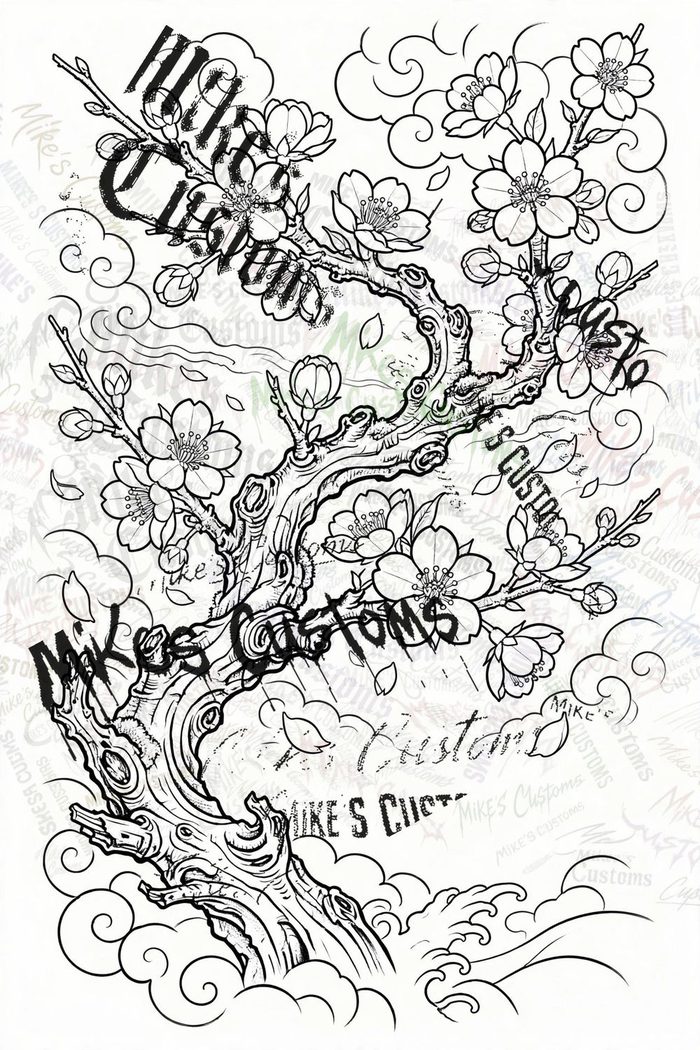
Color: pink is a commitment
Fresh cherry blossom pink is one of the softest colors in tattooing, and soft colors carry honest maintenance. Pale pink has little pigment load, so it fades faster than saturated color and far faster than black. On sun-exposed skin — forearms, shoulders, ankles in a sunny climate — a pastel blossom can need a refresh in five to eight years to keep reading as pink rather than as a pale shape.
Covered placements hold it much longer. Our aftercare guide covers the sunscreen habit that buys those extra years.
Artists work around this in three established ways:
- The first is contrast: a pink blossom outlined in firm black, with a few deep magenta or soft red accents at the center, keeps its structure even as the pale fill softens.
- The second is black and grey, where the blossom is built from wash and the petals read by shape alone — the meaning survives intact and the aging is the most graceful of any version.
- The third is the neo-Japanese route: bolder outlines, richer pinks pushed toward coral, and background shapes that frame the flowers so fading fill never carries the design alone.
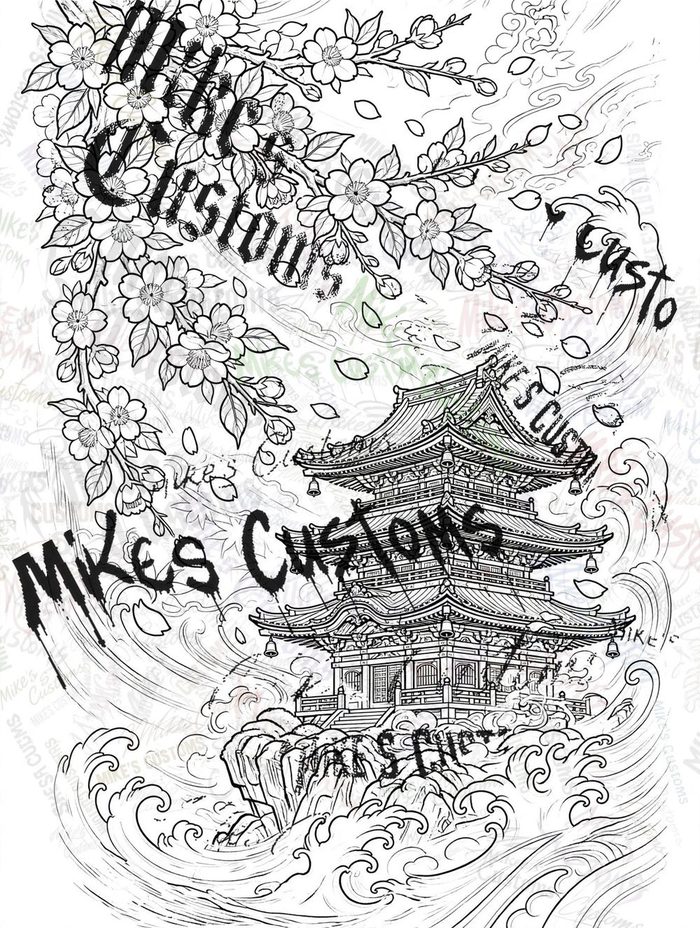
If your heart is set on watercolor blossoms with no outline, hear the trade plainly: they are beautiful for the first years and the fastest of all to blur, because nothing fences the pigment in. Some wearers accept that as fitting the subject — a tattoo about impermanence that itself fades — and if that reasoning is truly yours, it is a coherent choice. Just make it as a choice, not as a surprise.
Placement and size: where blossoms live
Cherry blossom is one of the most placeable subjects in tattooing because it scales by count: one flower, three flowers, a branch, a tree. The honest floors are about petal separation. A single blossom needs about an inch and a half to two inches across for its five petals and notched tips to stay distinct; below that, simplify to a silhouette or a four-shape stylized flower and accept the abstraction.
Branches want a run of skin that lets them curve: the forearm's outer edge, the ribs, the shoulder sweeping toward the chest, the spine, the top of a foot trailing toward the ankle. In Japanese work, blossom rarely sits alone on a large canvas — it rides with wind bars, water, or companions like the koi tattoo, where petals on the water's surface mark the season while the fish carries perseverance underneath. That pairing is a complete sentence: effort, inside a life that will not last forever.
Placement also tunes the meaning's volume. A blossom behind the ear or on an ankle is a private reminder. A branch across the shoulder or down the back is a public statement about how the wearer sees life.
A sternum or chest branch, close to the heart, is the memorial placement most often chosen for a person lost young. None is the correct reading — but choose on purpose, and use the mirror check in our stencil-day guide to see how a curving branch sits when you stand naturally, not just when you pose for it.
How a blossom ages
The failure mode is merged petals. Five petals drawn tight, with hairline gaps, become one pink cloud as lines soften over the years — the same size-and-detail law that governs a moon tattoo's fine phases. The fixes are all at the drawing stage: fewer petals per cluster, wider open skin between flowers, a branch line bold enough to organize the piece after the softest details settle.
Stamens and tiny center dots go first and should never carry the design. Petal notch lines soften next. What lasts is shape and contrast — which is why traditional and neo-Japanese blossoms, drawn with real outlines, look like blossoms at thirty years while delicate no-outline pieces often need rework at ten. Black and grey blossoms age the most evenly of all, trading the pink for permanence.
That trade is the subject in miniature, and artists will say so in consultation: this is the one tattoo where how it ages is part of what it means. Decide in advance whether yours will be maintained in color, allowed to fade with intention, or drawn in black and grey to outlast the metaphor. Our guide to choosing a design that ages well lays out the same decision for every floral subject.
Choosing yours
Decide the tense first — moment, season, or letting go — because it picks the form. Then decide the color bargain honestly, then let placement follow the branch or the single bloom you chose. The gallery's Flowers & Botanicals shelf holds single blossoms, full branches, and neo-Japanese pieces with temple and background work, each with the finished art and the stencil-ready linework.
For style grounding before you order, the Japanese (Irezumi) style guide explains how blossom sits inside larger traditional composition, including the wind and water backgrounds that carry it. And if your blossom marks a specific person or a specific spring, the custom desk can draw your branch with the petal count, the falling pattern, and the one detail that makes it yours. A flower that lasts a week has held its meaning for a thousand years. Drawn with room and contrast, yours will hold it too.
Keep reading
Browse the Flowers & Botanicals shelf in the gallery, or read How to Choose a Tattoo Design That Ages Well and the Japanese (Irezumi) style guide.
More from the article series:
- When Your Muse Has No GPU: Two Compute Workarounds Worth Knowing — November 18, 2026
- Phoenix Tattoo Meaning: Rebirth, Fire, and Rising on Your Own Terms — November 16, 2026
- Cross Tattoo Meaning: Faith, Memory, and the Forms It Takes — November 16, 2026