Phoenix Tattoo Meaning: Rebirth, Fire, and Rising on Your Own Terms
A phoenix tattoo means a life that burned down and did not stay down. The traditions behind the bird — Greek fire, Egyptian renewal, the Chinese Fenghuang that never burns at all — and the size, pose, and style choices that decide what yours actually says.
A phoenix tattoo means rebirth on purpose: a life, a self, or a chapter that burned down and did not stay down. People choose it after recovery, divorce, illness, grief, a career that ended, or a version of themselves they worked hard to leave behind — and the point is never just survival. The phoenix does not crawl out of the ash apologizing. It rises in full color, wings open, and that posture is the meaning.
That is why the phoenix sits apart from quieter symbols of change. A butterfly tattoo speaks about transformation as growth, stage by stage. A phoenix speaks about transformation as fire first. Something ended completely, and what came next was built from the remains on purpose.
Where the phoenix comes from
The bird that dies in flame and returns is older than any single culture, and each tradition hands tattooing a slightly different bird. In Egypt, the Bennu — a heron-like bird linked to the sun god Ra and to the flooding Nile — stood for renewal and the return of life on a cycle nobody could stop. Greek writers picked up the story and gave us the phoenix by name: a long-lived bird that builds its own funeral pyre, burns, and rises young from the ash.
China has the Fenghuang, and it is worth separating from the Greek bird because the two get tangled in flash books. The Fenghuang does not burn and does not die. It is a composite bird of virtue, grace, and right rule, appearing when the world is in order.
Japan's Houou carries a similar weight — peace, legitimacy, and a good age arriving. A Fenghuang or Houou tattoo says harmony and virtue. A Greek-style phoenix says I burned and came back.
Both are fine sentences. They are not the same sentence.
Slavic folklore adds the firebird, a glowing bird whose feathers light the dark and whose pursuit drives whole quests. Modern tattooing borrows its flame-feathered look more than its story, but the glow is the point there too: something bright that cannot be held for long.
| Tradition | What the bird means | How it tends to be drawn |
|---|---|---|
| Egyptian Bennu | Renewal, the sun, life returning on its cycle | Heron profile, long legs, sun disc, upright and calm |
| Greek phoenix | Death by fire and rebirth, endurance across centuries | Eagle-like body, flame feathers, wings raised from a pyre or ash |
| Chinese Fenghuang | Virtue, grace, harmony, right order | Flowing tail plumes, peacock and pheasant features, no flames |
| Japanese Houou | Peace, good government, a fortunate age | Long sweeping tail, paulownia or bamboo company, irezumi flow |
| Modern recovery phoenix | Personal comeback after addiction, illness, or loss | Rising pose, ash and embers below, dates or words worked into the tail |
Knowing which bird you mean settles half the design argument before it starts. If your story is a comeback, you want the burning bird, drawn rising. If your story is balance and grace, the Fenghuang's long plumes will serve you better than flames ever will.
Fire, ash, and the rising pose
Three visual choices carry most of a phoenix tattoo's meaning, and each one is worth deciding out loud with your artist. The first is the pose. A phoenix with wings raised and head up is mid-rise — the comeback in progress, defiant and public.
A phoenix with wings wrapped around itself is earlier in the story: protecting what is left, still in the ash. A phoenix in full flight, tail streaming, is past the fire entirely. People point at the rising pose most often, and it is the hardest to draw well, because the wings have to lift the whole composition instead of hanging on it.
The second choice is the fire itself. Flames at the base, embers in the tail, and a bird drawn clean above them says the fire is behind you. A bird wreathed in flame from beak to tail says you are still in it, or that the fire is part of you rather than a thing that happened to you. Neither reading is wrong, but they age differently as life moves on, so pick the one you will still mean in ten years.
The third choice is the ash. Grey wash, broken ground, or scattered embers under the bird ground the design and give the bright feathers something to rise from. Skip the ash and the phoenix reads more decorative — closer to the Fenghuang's calm. Keep it, and the story stays legible to anyone who looks twice.
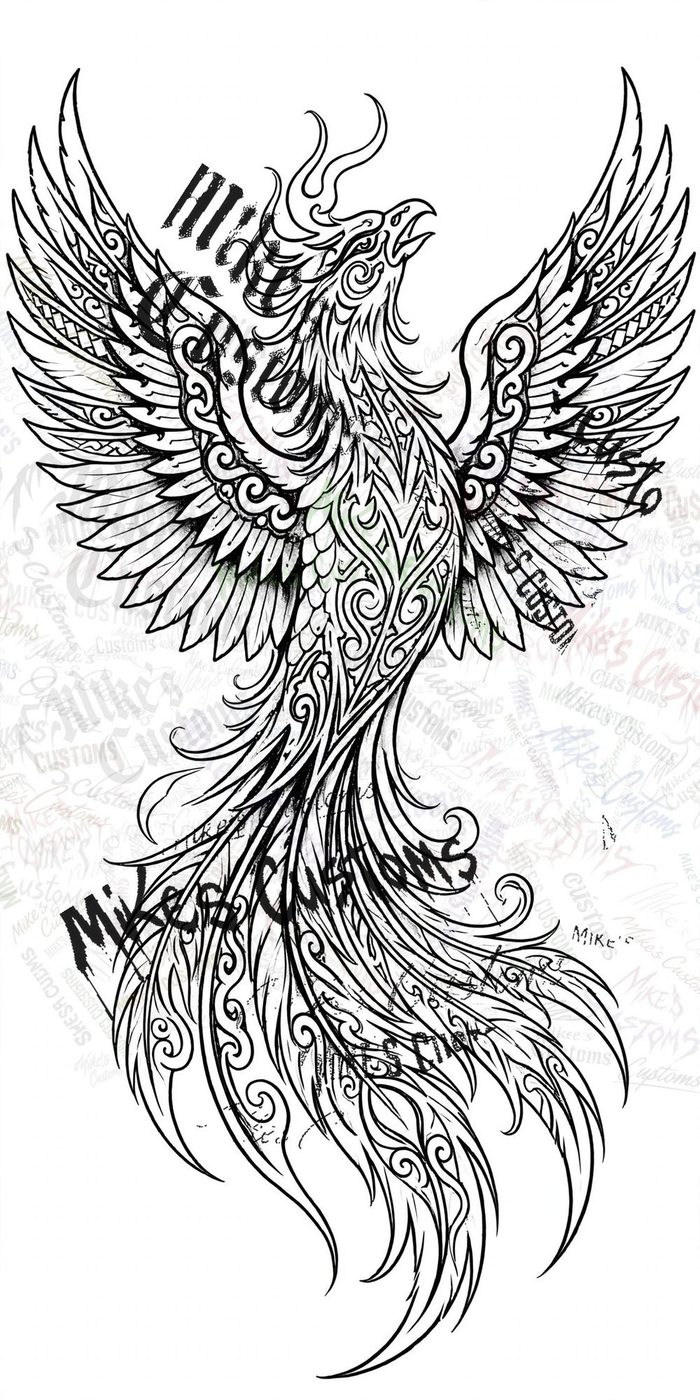
That bold end of the shelf matters. A tribal or blackwork phoenix trades feather detail for silhouette, and silhouette is what a stranger reads from across a room. If you want the meaning to land at a glance, that trade is often the right one — the Blackwork style guide shows how much story solid black can hold.
The forms a phoenix takes
At the detailed end sits the full color phoenix: layered flame feathers in red, orange, and gold, a proper bird's head with an eye that has to survive for decades, and a tail that can run a foot or more on a back or thigh. Japanese-style Houou work belongs here too, usually with background — wind, clouds, or flowers — carrying the tail across the body the way a dragon tattoo uses waves and wind bars. The company matters in that tradition: a phoenix paired with a dragon is a classic balance emblem, two powers checking each other.
In the middle sits black and grey: the bird built from wash and soft shading, embers dotted in, flames suggested by negative space. It reads quieter and more memorial, and it suits comeback stories that are private rather than declared. At the stripped end sit tribal, cybersigilism, and fine-line phoenixes — the bird reduced to a rising shape, a few flame tongues, a beak line. Those designs can go smaller, but only because they have given up the feather-by-feather detail.
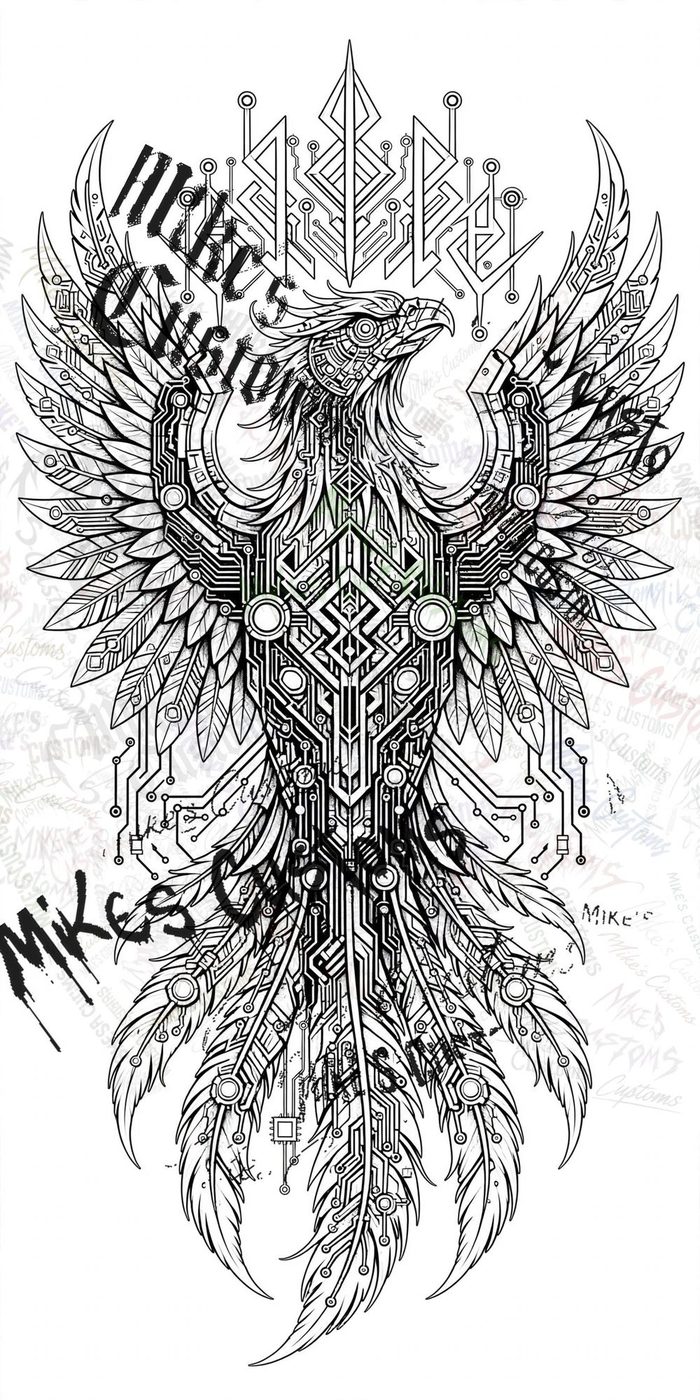
Cybersigilism deserves a plain warning alongside the praise. Its thin, sharp points look striking fresh, and they are the fastest part of any phoenix to soften. Drawn too small, the spikes merge into a dark smudge within a few years. If that style is yours, give it room — a forearm length, a sternum width, a calf — and keep the points separated by real open skin, not hairlines of it.
Size and placement, honestly
A phoenix is a wide, tall design by nature. Wings want width; a tail wants length. The placements that respect both are the back, the chest, the thigh, the ribs, and a full upper arm where the bird can wrap. A back phoenix can carry the full story — pyre at the base of the spine, wings across the shoulder blades, head rising toward the neck — and it is the classic choice for a reason.
Size floors follow detail, as they do everywhere in tattooing:
- A fully feathered color phoenix wants eight inches or more in its longest run, and ten to twelve is happier.
- A blackwork or tribal phoenix with bold shapes can read at five to six inches.
- A minimal line phoenix can work at three to four inches if the artist cuts the feather count hard and keeps the beak and eye simple.
Below that, you no longer have a phoenix; you have a flame with ambitions.
Ribs deserve a specific note: the canvas is excellent and the tail can follow the body's curve beautifully, but it is tender skin that moves with every breath, so sessions run slower. Sternum placements suit symmetrical rising designs and sit close to the heart, which many wearers mean literally. Forearms suit the vertical, narrow phoenix — wings folded up rather than spread — and our guide to choosing a design that ages well walks through the size-and-detail trade in full.
Before any of it is permanent, do the mirror check described in the stencil-day guide: wings read very differently at rest and with your arms raised, and a phoenix is a design you will watch move.
How a phoenix ages
The weak points are predictable. Fine feather separations merge first, especially where reds and oranges meet without a dark line between them. Thin tail streamers soften and can break up visually if they were drawn too narrow. Small eyes vanish — experienced artists draw the head and eye larger than strict proportion suggests, the same fix used on dragons and on koi tattoos, whose faces face the same problem.
Color phoenixes carry a second bill: red, orange, and yellow pigments are spent by sun faster than black ever is. A phoenix on a shoulder or forearm that works outdoors will need the sunscreen habit, covered in our aftercare guide, or it will need a color refresh years sooner than a covered back piece. Blackwork phoenixes skip that bill almost entirely and hold their silhouette for decades, which is why so many comeback pieces — worn by people who do not want the story to fade in any sense — end up in solid black.
One more aging truth: negative space is structure. The gaps between flame feathers, between wing and body, between tail plumes — those gaps are what keep the bird readable at year twenty. A design that looks slightly too open on paper is usually drawn exactly right for skin.
Who a phoenix suits, and what to pair it with
The phoenix suits people marking a before and an after. It is one of the few large designs whose meaning strangers get right without being told, which cuts both ways: if your comeback is a story you are willing to have asked about, the phoenix will start those conversations. If it is private, place it where clothing decides who sees it, or let black and grey quiet it down.
Pairings steer the reading. Ash and embers keep it in the fire story. Flowers soften it toward renewal — cherry blossom is the pairing Japanese work reaches for, growth after burning.
A date, a name, or a short line of lettering in the tail makes it a memorial as much as a comeback, the same way a snake tattoo can be turned toward a specific shedding by what it coils around. Skulls push it darker, toward death faced rather than death survived. Choose the company as carefully as the bird.
Choosing yours
Start with the tradition, because it decides whether your bird burns at all. Then settle the pose — rising, wrapped, or in flight — then the fire and ash, then the style, and only then the size, letting the detail you keep set the floor. The gallery's Mythology & Fantasy shelf holds the range from tribal blackwork to sharp cybersigilism work, and every design ships with the finished artwork and the clean linework your artist stencils from.
If your phoenix needs a specific date in the tail, a name in the ash, or your own bird drawn from a brief, the custom desk builds it that way. A phoenix is a declaration that the worst chapter was not the last one. Drawn bold, sized honestly, and placed where its wings have room, it will still be making that declaration decades from now.
Keep reading
Browse the Mythology & Fantasy shelf in the gallery, or read How to Choose a Tattoo Design That Ages Well and the Blackwork style guide.
More from the article series:
- When Your Muse Has No GPU: Two Compute Workarounds Worth Knowing — November 18, 2026
- Cherry Blossom Tattoo Meaning: Beauty That Knows It Is Brief — November 16, 2026
- Cross Tattoo Meaning: Faith, Memory, and the Forms It Takes — November 16, 2026