Blackwork Tattoos: The Complete Guide
Black ink only, used at full strength: bold graphic shapes, heavy saturation, ornamental pattern and dark illustrative work with no grey wash and no color.
Blackwork is an umbrella for everything done in pure black ink at full saturation — no greywash gradients, no color. Under it live tribal and neo-tribal, ornamental and decorative pattern work, dark illustrative and engraving-style pieces, bold graphic and abstract designs, and the heavy blackout work used to cover old tattoos or make a statement of pure shape.
The style's roots run from the indigenous tattooing of Polynesia and Borneo through 1990s tribal to today's ornamental revival. What unites it is commitment: blackwork does not whisper. A blackwork piece is a silhouette first — it reads from across the street — and its detail lives in pattern, texture and the play between saturated black and open skin.
Blackwork at a glance
| Line weight | Solid black fields with confident lines and negative-space carving |
|---|---|
| Palette | Pure black ink only, at full saturation; no greywash, no color |
| How it ages | Lowest maintenance; edges soften slightly, fine skin-gaps can narrow |
| Best placements | Limbs as bands and sleeves, sternum, spine, back; best for cover-ups |
| Minimum size | Scales from a small bold symbol up; fine reverse detail needs extra room |
How Blackwork designs are drawn
A blackwork design is built from solid black fields, confident linework, and texture made of dots, hatching or negative-space carving. Skin is the second ink: the shapes left untattooed inside a blackwork piece — a flower cut out of a black panel, a white line winding through a band — are drawn as deliberately as the black. Symmetry and repetition are common tools, especially in ornamental work that follows the body's own geometry: sternum pieces, back pieces, bands and sleeves built like architecture.
Best placements for Blackwork tattoos
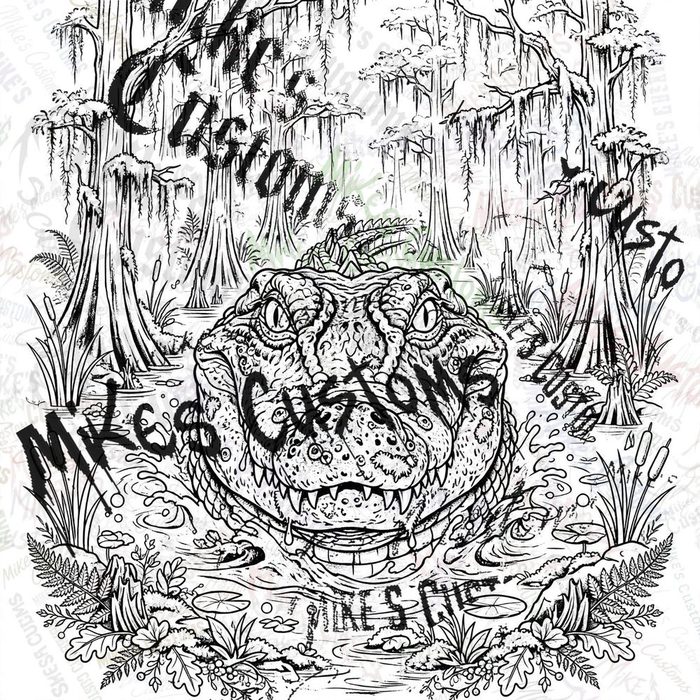
Blackwork is the most placement-flexible style because it is shape-driven: it wraps limbs as bands and sleeves, mirrors itself across the sternum, spine and back, and fills awkward leftover spaces between other tattoos better than any other style. It is also the go-to for cover-ups, since solid black is the only thing that reliably buries an old tattoo. Mind the body's symmetry lines — ornamental blackwork looks its best centered and mirrored with intention.
Blackwork placement has a heat and coverage side that rarely gets mentioned. Large solid fields on the back, chest or thigh absorb noticeable heat in direct summer sun and can feel hot to the touch, which matters to people who work outdoors and to anyone planning a big black panel in a hot climate. Ornamental pieces centered on the sternum or spine live or die on posture during stenciling: stand straight, breathe normally and check both sides in a mirror, because a design centered while you twist toward the light will sit off-axis all day. Bands around the forearm or calf must be measured around the muscle at rest and flexed, since a band drawn to close perfectly on a relaxed calf can gap or pinch visually when it contracts. For cover-up work the old tattoo dictates placement more than taste does: the new black shapes need to extend beyond the old edges, use the darkest parts of the old piece inside the darkest parts of the new one, and sometimes need one session purely to pack black before detail can be carved back with negative space.
How big does a Blackwork tattoo need to be?
Blackwork scales in both directions unusually well. A small, simple black symbol holds forever; a full blackwork sleeve is a major project of many sessions. The sizing rule is about pattern density: fine dot texture and thin negative-space lines need room, because tattooed black spreads slightly over the years and a one-millimeter white gap can close. If a design has fine reverse detail, your artist may scale it up or simplify the pattern — that advice is the style's physics, not upselling.
How Blackwork tattoos age
Solid black is the most permanent thing in tattooing. Blackwork ages by softening at the edges: crisp borders relax a little, and very fine negative-space details can narrow as pigment settles. Bold shapes are effectively forever. Heavy black does absorb more sun heat and can look grey-blue in harsh light on some skin tones; moisturizer and sunscreen keep it deep. Of all styles, blackwork asks the least maintenance — which is part of its appeal.
Healing solid black is its own discipline. A large saturated field forms a broad, tight scab plate, and bending a joint under it can crack that plate and open a line that heals lighter than the surrounding black; artists often schedule elbows, knees and hands expecting a second pass for exactly this reason. Keep big black work moisturized in thin layers, never greasy enough to stick to clothing, and expect it to look grey and ashy while the new surface skin is still matte, deepening again once healing finishes. In the chair, packing black is slow, repetitive work and the skin can only take so much of it in one area before it stops accepting pigment cleanly, which is why blackout and heavy ornamental projects are staged. Blackwork suits people who are certain, because solid black is the hardest work to remove or rework later. It does not suit anyone testing whether they like being tattooed, anyone who may want color in the same spot later, or anyone expecting fine white-on-black detail to stay hairline-thin for decades.
Choosing a Blackwork design
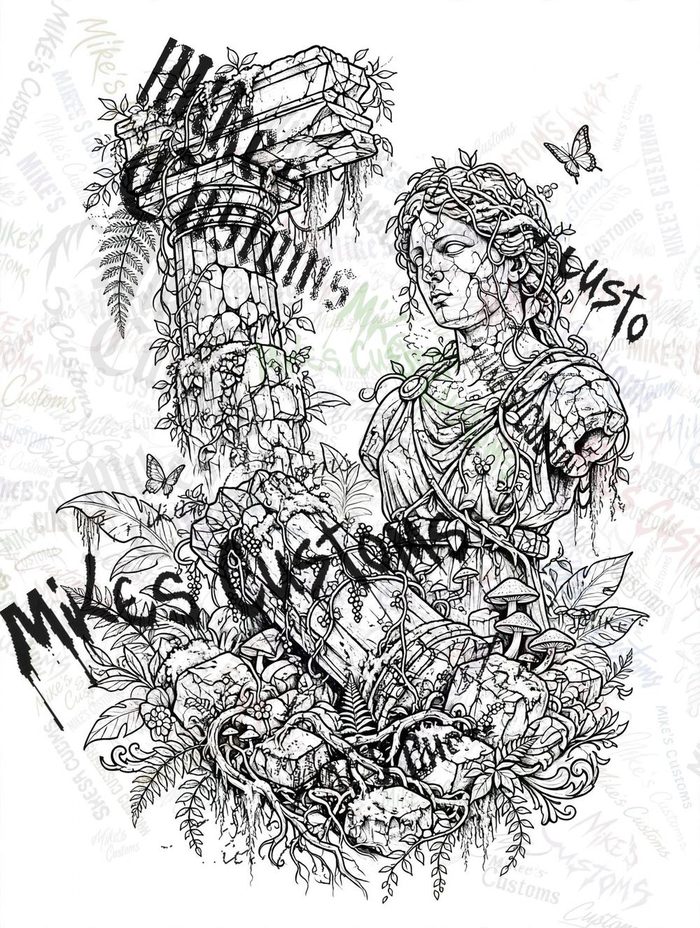
Judge blackwork designs in silhouette: cover the detail and look at the shape. Our blackwork pieces ship as linework-forward files, since the drawing is the tattoo. For cover-ups, order custom and tell us what is underneath — size, darkness and placement of the old piece — because a cover-up design is engineered around the specific tattoo it has to bury.
Browse Blackwork designs Order a custom Blackwork design
Related style guides
- Fine Line — Delicate single-needle tattooing: hair-thin lines, tiny script, small botanicals and minimalist pieces with an airy, drawn-on-with-a-pen feel.
- Watercolor — Painterly tattooing that mimics wet pigment: splashes, drips, bleeds and translucent color washes, usually anchored by a black linework subject at the center.
- Geometric & Sacred Geometry — Precision-built tattooing: mandalas, sacred geometry, symmetry, pattern and line systems drawn on grids so the math survives the move to curved skin.
New to all of this? Start with how to choose a tattoo design that ages well, then the complete aftercare guide for what happens after the appointment.