Geometric & Sacred Geometry Tattoos: The Complete Guide
Precision-built tattooing: mandalas, sacred geometry, symmetry, pattern and line systems drawn on grids so the math survives the move to curved skin.
Geometric tattooing builds images from pure structure: circles, triangles, hexagons, repeating patterns, and the interlocking diagrams known as sacred geometry — the Flower of Life, Metatron's cube, Sri Yantra and their kin. Alongside it sits the mandala tradition, radial designs radiating from a center point, borrowed from Hindu and Buddhist art and adapted into one of tattooing's most popular forms.
The style appeals to people who like their tattoos to feel inevitable — every line where mathematics says it should be. Getting there is the hard part: the design must be drawn on a true grid, because skin stretches, curves and moves, and geometric work shows every millimeter of error that an organic design would forgive.
Geometric & Sacred Geometry at a glance
| Line weight | Uniform, crisp lines drawn on a true grid; dotwork shading |
|---|---|
| Palette | Usually black only; color used sparingly inside the structure |
| How it ages | Stays readable; loses machined crispness at the edges first |
| Best placements | Sternum, spine, chest and mid-back for centered work; shoulders for radial |
| Minimum size | Simple emblems at 2 inches; dense patterns need 4 to 6 inches |
How Geometric & Sacred Geometry designs are drawn
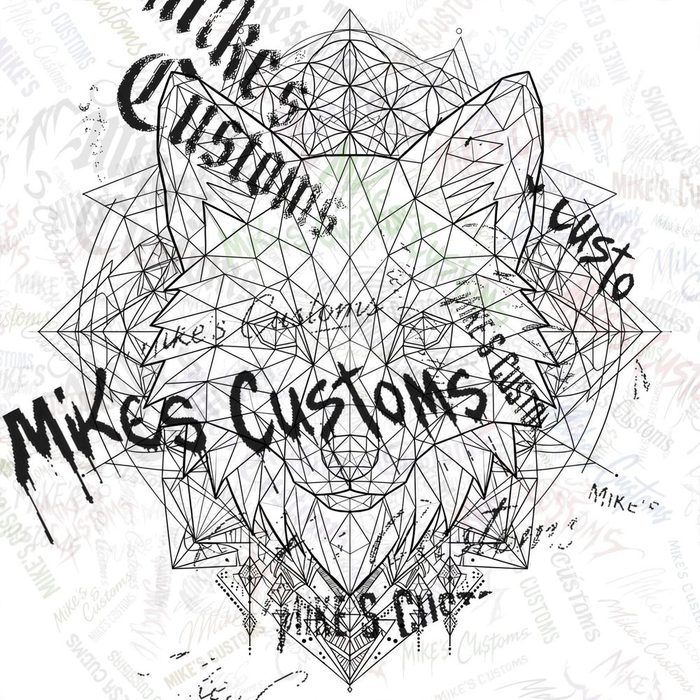
A geometric design is engineered: perfect circles, straight rules, mirrored halves, pattern repeats that tile without a seam. Line weights are usually uniform and crisp, with dotwork shading used to soften transitions without breaking the geometry. Subjects from nature — animals, flowers, faces — are often rebuilt from facets and symmetry, half geometric diagram, half living thing. The drawing is only half the art; the stencil transfer, done with the body in a natural stance, is the other half.
Best placements for Geometric & Sacred Geometry tattoos
Symmetry is the placement question. Centered pieces belong on the body's center lines — sternum, spine, chest, forehead of the back — where the design's mirror axis matches the body's. Radial mandalas sit beautifully on shoulders, elbows, knees and the center of the back. Long geometric bands wrap forearms and calves. Avoid placing strict geometry over areas that twist hard (the waist, the wrist's working side) unless the design is built to move with them.
Geometric placement fails in predictable places, and knowing them saves a piece. A perfect circle placed over the kneecap, elbow point or shoulder ball will not stay a circle in every position, so radial designs there are either drawn to be correct in the body's resting pose, accepting distortion in motion, or rebuilt as patterns that tolerate movement. Long straight lines down the spine need the stencil applied standing, because skin drawn while bent over a chair back shifts by centimeters when you straighten up. Matching geometric pieces on both arms or both legs will never be perfectly identical, since bodies are not symmetrical; good artists mirror the design's logic rather than promising a photocopy. Forearm geometry has to survive rotation: a band or grid that aligns with the palm up can shear noticeably with the palm down, so check the stencil in both positions. Areas with substantial stretch, such as the outer hip and stomach, can pull a grid visibly out of square with weight change, making the upper back, chest and calves safer ground for strict pattern work.
How big does a Geometric & Sacred Geometry tattoo need to be?
Geometry scales by pattern density. A simple bold emblem — a triangle, an eye, a small mandala — works at two inches. Dense sacred-geometry pieces with fine internal patterns need four to six inches minimum, or the interior structure crowds into texture as lines settle with age. Large-scale geometry (full back mandalas, chest pieces) is where the style is most spectacular, and those pieces are planned as single compositions, not enlarged small ones.
How Geometric & Sacred Geometry tattoos age
Crisp lines soften slightly in every tattoo, and in geometric work softening shows as a loss of machined perfection rather than readability — the piece still reads, it just becomes hand-made around the edges. Bold-line geometry ages best; pieces built from hairline patterns blur toward each other fastest. A good geometric artist builds in margin: line spacing chosen with a decade in mind, not just the fresh photo.
The session side of geometry is slower than its clean result suggests. Much of the time is spent before the needle touches skin: measuring, marking center lines, applying the stencil in sections and checking it from distance and in a mirror, and redoing a transfer that sits two millimeters off is professionalism, not fussiness. During tattooing, long straight pulls are done in single controlled passes where the artist's breathing and the client's stillness both show in the result, so fidgety placements and rushed appointments work against the style. Healing has one specific trap: a scab lost early from a single line in a pattern leaves a gap that the eye finds instantly, because the surrounding regularity advertises it, so geometric work over joints should be kept as still as the body allows for the first week. Geometry suits precise people who will choose an artist for straight healed lines and accept larger sizes for dense patterns. It does not suit anyone wanting a quick walk-in version of a complex diagram, a tiny copy of a full sacred-geometry poster, or perfect symmetry promised on an asymmetrical body part.
Choosing a Geometric & Sacred Geometry design
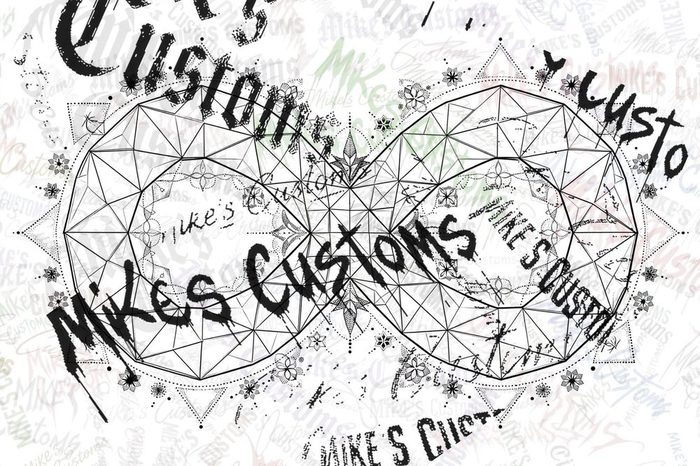
Our geometric designs are drawn on grids, and the linework files carry the symmetry exactly — your artist's job is the careful transfer, so pick someone who tattoos straight lines happily. Custom geometric orders should state the placement up front: a sternum mandala and a forearm mandala are engineered differently, and telling us the canvas lets us draw for it.
Browse Geometric & Sacred Geometry designs Order a custom Geometric & Sacred Geometry design
Related style guides
- Dotwork — Images built entirely from dots: shading, gradients and whole pictures stippled point by point, from soft grey fog to dense black pattern.
- Mandala — Radial designs blooming from a center point — petals, dots, lace and geometry in perfect symmetry, from a two-inch accent to a full back.
- Tribal — Bold black flowing shapes rooted in indigenous tattoo traditions — Polynesian, Māori, Samoan, Bornean and Haida — and the sharp, sweeping tribal style that swept the 1990s.
New to all of this? Start with how to choose a tattoo design that ages well, then the complete aftercare guide for what happens after the appointment.