Feather Tattoo Meaning: Freedom, Flight, and Letting Go Lightly
A feather tattoo means freedom and a lighter life — but the bird it came from decides the sentence, from an eagle's honor to an owl's wisdom to a hummingbird's joy. The traditions, the forms, and the barb-spacing rules that keep a fine feather readable for life.
A feather tattoo means freedom and lightness: the ability to move, to travel, to let go of weight and not be held down. It is worn for a life made lighter on purpose — grief set down, a place left, a self unburdened — and for the older meanings the feather carries underneath the modern one: truth, protection, and a connection between the earth and the sky. Which bird the feather came from decides which of those meanings leads.
That last part is the part most people skip, and it is the part that makes the design. A feather with no bird named is a general wish. A feather from a specific bird is a sentence.
Truth, spirits, and the sky: where feather meanings come from
The oldest formal feather symbolism tattooing inherits is Egyptian. In the judgment scenes of ancient Egypt, the heart of the dead was weighed against the feather of Ma'at — goddess of truth and right order. A heart heavier than the feather had lived badly.
A heart that balanced had lived true. A feather tattoo chosen from that root means honesty and a clear conscience: living light enough to pass the scale.
In many Native American nations, feathers — eagle feathers above all — are sacred objects of honor, prayer, and connection to the Creator, given to mark bravery and carried with ceremony. That is living tradition, not decoration, and it sets a respectful boundary for tattooing: an eagle feather design means honor and spiritual connection to the wearers who claim it, and copying specific ceremonial regalia as a fashion piece is the one feather choice artists will talk you out of. A generic feather drawn in your own style makes no claim it cannot back. Know the difference and stay on the right side of it.
Elsewhere the feather follows the bird. Celtic and European folk traditions tied feathers to the birds that dropped them — swan feathers for love and dreams, crow feathers for the battlefield and the dead, owl feathers for wisdom and seeing in the dark. Writers claimed the feather early too: a quill is a feather, so feather tattoos also serve authors, poets, and anyone whose freedom is specifically the freedom to say the thing.
| Feather | What it tends to mean | Drawing notes |
|---|---|---|
| Eagle | Honor, courage, spiritual connection, protection | Long, broad, barred markings; treat the source with respect, draw it large enough to read |
| Owl | Wisdom, intuition, seeing what others miss | Soft, muted barring; pairs naturally with moon and night elements |
| Raven or crow | Intelligence, mystery, messages between worlds, survival | Drawn in black or black and grey; sheen suggested with open skin, not blue fill |
| Hummingbird feather / wings | Joy, energy, lightness, hovering between places | Iridescent color is fragile; bold shapes with jewel tones hold better than washes |
| Peacock | Beauty, pride, renewal, being fully seen | The eye of the feather is the whole design; it needs width to stay an eye |
| Songbird / generic | Freedom, travel, letting go, a light heart | The fine-line standard; keep barbs few and separated so it ages as a feather |
| Quill | Writing, voice, a story claimed as your own | Often paired with an inkwell, a word, or birds breaking away from its tip |
The forms: single feather, falling feather, birds breaking free
The single upright feather is the classic: one shaft, barbs falling away on both sides, a slight curve that gives it life. It is a vertical design, and vertical designs are placement gifts — they run down a forearm, a spine, a ribcage, the back of a calf, or behind an arm without fighting the body. Drawn well, its meaning reads as freedom held calmly: not escape, just lightness.
The falling or floating feather leans into letting go. Drifting at an angle, sometimes with a curl at the tip, it is the form chosen after a loss or a leaving — the weight released, still visible, no longer carried. It pairs with wind, with script, and with empty space; the emptiness around it is part of the drawing, the sky it is falling through.
The best-known modern composition breaks the feather apart: solid at the base, dissolving at the tip into a small flock of birds flying free. It says the thing plainly — what was one held, heavy thing becomes many light ones, gone into the sky. It is a beautiful idea that lives or dies on size, because each little bird needs to stay a bird.
Drawn too small, the flock becomes flecks. If this is your design, budget the inches for the birds, or simplify to two or three larger birds and let them carry it.
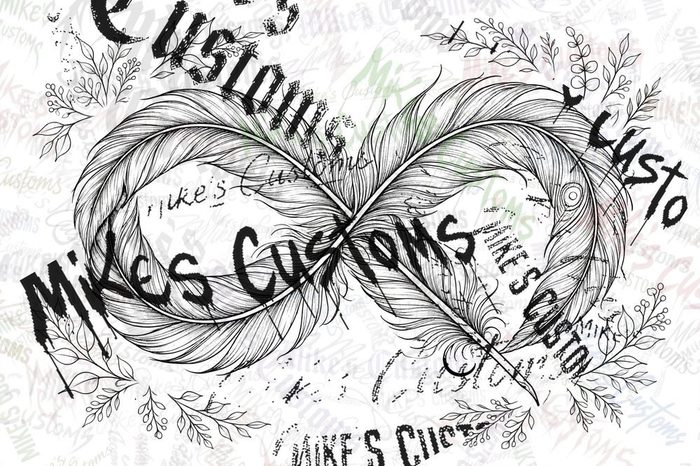
The infinity feather — a feather whose shaft curves into an infinity loop — adds permanence to the lightness: freedom not as a phase but as a permanent condition, or a bond with someone that itself feels like freedom. It is usually drawn in fine line, and it is the form where line discipline matters most, because the loop and the barbs compete for the same small space. Our Fine Line style guide shows the spacing that keeps that competition fair.
Wings, hummingbirds, and the wider family
Feathers rarely stay single for long in a tattoo plan. They gather into wings — on a back, a chest, or split across two shoulder blades — and a wing changes the meaning from lightness carried to flight claimed outright. Wings are a commitment of canvas and sessions, planned the way a wolf tattoo's fur is planned: feather rows are repeated detail, and repeated detail is bought with size or simplified into bold layered shapes.
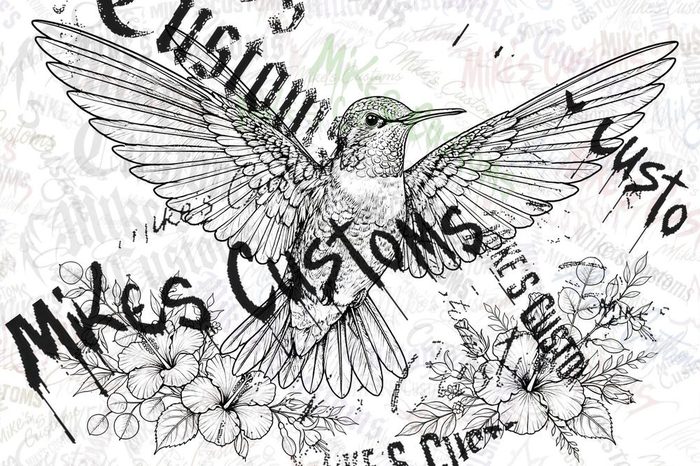
The hummingbird deserves its own word, because it is the feathered creature people choose when the meaning is joy rather than escape. Hummingbirds stand for energy, sweetness, and a lightness that hovers — present, busy, and unbothered. A hummingbird or its wings in realism color is jewel-box work: greens, teals, and ruby at the throat.
Those iridescent colors are the fastest-fading part of any bird tattoo, so the design needs dark structure underneath the color and a wearer willing to keep sun off it, per our aftercare guide. Drawn in black and grey instead, the same bird trades the jewel effect for decades of clean reading.
Feathers also serve as the connective tissue of larger pieces: tucked into a compass tattoo for the traveler, trailing from a dreamcatcher, worked into a moon tattoo's crescent for the night-minded, or scattered under a larger bird as it takes off. In each case the feather is doing the same job — it is the part of the design that says light, loose, and unheld.
Placement and size: the honest floors
A feather's enemy is its own detail. The barbs — the fine lines running off the central shaft — are close parallel lines, and close parallel lines are exactly what skin merges as years pass. The floors follow from that.
- A fine-line feather with simplified barbs can work at two to three inches long if the barb count stays low and the gaps stay wide.
- A detailed feather with realistic barb texture wants four to six inches.
- A feather dissolving into birds wants six inches or more, with the birds drawn no smaller than half an inch each.
Placement should follow the feather's own direction. Spines, forearms, ribs, calves, and the sternum all give a feather a natural vertical run. The collarbone and the top of the foot suit the curved, drifting forms.
Behind the ear and on the inner wrist suit the smallest simplified feathers — a single shaft with a few barbs, more symbol than specimen. Our guide to choosing a design that ages well makes the general case, and the stencil-day guide covers the mirror check that shows you how a long design sits when your arm hangs naturally rather than posed.
One placement note specific to feathers: they read by silhouette against open skin, so they suffer on heavily freckled or already-tattooed ground unless the artist adds contrast — a soft grey wash shadow behind the feather, or a bolder outline than the reference photo suggests. Ask for that contrast at the drawing stage, not the touch-up stage.
How a feather ages
Expect the barbs to soften first and the shaft to outlast everything — which is the correct order, because a feather reduced by time to a clean shaft with suggested barbs still reads as a feather. What fails is the opposite drawing: wispy shaft, fussy barbs, watercolor color with no line to hold it. In five years that is a smudge with a story nobody can see.
Black and grey feathers age the most gracefully, then bold fine-line, then color realism, then watercolor last — the same ladder as the butterfly tattoo, whose soft wings face the identical physics. If your feather is small and fine, plan on one touch-up in the first few years as a normal cost of the style; artists who do fine-line work will tell you this upfront, and it is maintenance, not failure.
Dreamcatcher feathers and other dangling elements add one more aging note: strings and beads are thin lines and small dots in a row, and both spread slightly. Drawn with real spacing they age into a soft, believable texture. Drawn tight, they age into a braid. Choose the spacing while it is still a choice.
Choosing yours
Name the bird first, even if the answer is a plain songbird — it decides the feather's shape, markings, and meaning in one move. Then choose the form: held upright, falling, breaking into birds, or looped into infinity. Then set the size by the barb detail you refuse to give up, and simplify the drawing until the silhouette alone says feather.
The gallery's Animals & Wildlife shelf holds fine-line feathers, realism wings, and hummingbird work, each with the finished art and the clean linework your artist stencils from. If your feather stands for a specific leaving, a specific person, or a specific bird you watched out a window for years, the custom desk draws it from that brief. A feather is the lightest subject in tattooing. Drawn with room between its lines, it stays light for life.
Keep reading
Browse the Animals & Wildlife shelf in the gallery, or read How to Choose a Tattoo Design That Ages Well and the Fine Line style guide.
More from the article series:
- When Your Muse Has No GPU: Two Compute Workarounds Worth Knowing — November 18, 2026
- Phoenix Tattoo Meaning: Rebirth, Fire, and Rising on Your Own Terms — November 16, 2026
- Cherry Blossom Tattoo Meaning: Beauty That Knows It Is Brief — November 16, 2026